You stand at the vanity, watching the cloudy water stall. A swirl of toothpaste foam stubbornly lingers around the drain, mocking your morning routine. Under the sink sits a heavy plastic jug of thick, corrosive gel, promising a clear pipe in fifteen minutes.
It feels like the only logical option when you are staring at a mess. Pour the heavy liquid, wait for the ominous bubbling, and hope the block dissolves before the fumes give you a headache. But pouring industrial acid down your sink is akin to cleaning a delicate instrument with a blowtorch; you are quietly allowing chemicals to corrode your home from within.
The reality behind the drywall is much more delicate. Your home drainage network relies on gravity and smooth internal surfaces, not chemical warfare. When the acids heat up to melt away blockages, they warp the structural integrity of the plastic and weaken the seals on metal joints.
There is a quieter, infinitely more effective way to handle a backed-up sink. It requires no gloves, no harsh ventilation, and carries absolutely zero plumbing risk to your property.
The Anatomy of a Bottleneck
Think of your sink drain not as a bottomless pit, but as a carefully engineered throat. Just a few inches below the shiny metal ring lies the P-Trap, a curved section of pipe designed to hold a small amount of water. This standing water acts as a protective seal, keeping sewer gases from drifting back up into your bathroom.
But that necessary curve also creates a natural catching point. Shaving debris, sticky soap fats, and shed hair weave themselves together in the belly of the trap. Pouring liquid fire tries to burn through this mass, but the clog remains a physical obstruction, not a chemical one.
Arthur Vance, a third-generation plumber from Chicago with thirty years of call-outs under his belt, stopped buying commercial drain cleaners in the late nineties. He kept seeing melted pipes and burned skin, realizing the industry had sold homeowners a toxic, temporary fix.
Arthur discovered that a heavily modified zip-tie, a piece of plastic costing less than two cents, could clear ninety percent of bathroom clogs faster than any caustic gel. He calls it fishing the trap, an approach that respects the fragile internal system instead of indiscriminately attacking it.
The Geometry of Clogs
Not every bathroom obstruction builds up the same way. The method you use to approach the physical extraction depends entirely on the daily habits formed over that porcelain bowl.
- The upside-down shelf trick instantly doubles small kitchen storage space
- The winter storage mistake destroying your lawn mower blade before spring
- Major insurers begin rejecting homes with this specific spray foam insulation
- Plumbers warn this 5-minute basement check prevents catastrophic flooding
- Where contractors secretly buy premium walnut lumber for less than pine
- Historic copper shortage threatens to double home renovation costs this month
- The black tea method replacing expensive hardwood floor refinishing
- Master plumbers never use chemicals to clear a blocked bathroom sink
- Renters are using this $2 putty to install floating shelves without drilling
- The single drop of essential oil that restores rusted cast iron in seconds
For the Long-Haired Household
If your drains routinely swallow long strands, the blockage usually forms a tight, felt-like plug right at the pivot rod of the pop-up stopper. You rarely need to reach the actual curve of the pipe; the tangle hangs just below the surface.
For the Shaving Station
Whiskers mixed with thick, lipid-heavy shaving cream create a dense, clay-like sludge. This sits lower in the trap, settling like sediment. Physical extraction here requires scraping the walls of the pipe rather than just hooking a snag, pulling up chunks of dense soap fat.
For the Vintage Sink Owner
Older homes with brass or cast-iron traps require extreme gentleness. Acidic liquids will turn aged metal brittle, leading to a catastrophic leak behind the wall. The zip-tie method is the only intervention to preserve your aging metal fixtures safely.
The Three-Minute Zip-Tie Extraction
Forget the heavy wrenches and the safety goggles. This is a quiet, deliberate process that puts you directly in tune with your home mechanics.
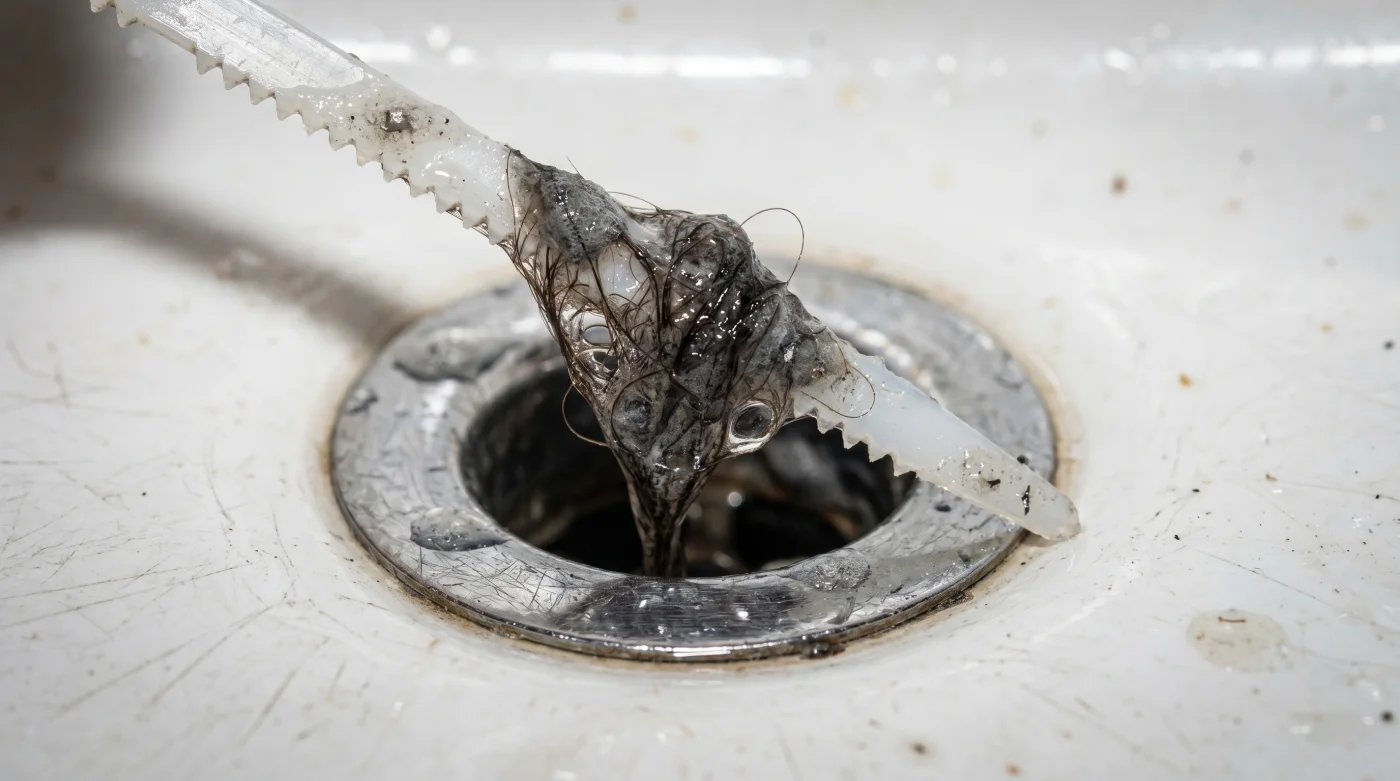
To build your extraction tool, grab a standard heavy-duty zip-tie, about ten inches long. Using a pair of diagonal cutters or sharp scissors, snip small, angled notches along both sides of the plastic tail. Point the cuts upward toward the square head. You are creating a miniature row of backward-facing barbs.
- One 10-inch nylon zip-tie
- Sharp scissors or wire snips
- A thick paper towel
- One empty trash bin placed near your knees
Once your tool is prepped, follow the physical path of the water.
- Remove the stopper: Twist it slightly and lift. If it is attached to a pivot rod behind the pipe, unscrew the retaining nut by hand and pull the rod back an inch to release the metal stopper.
- Feed the line: Slide the barbed plastic down into the dark throat of the drain. Push it until you feel the soft resistance of the clump at the bottom of the curve.
- Twist and pull: Rotate the line one full turn. The backward-facing notches will hook securely into the matted hair and soap sludge.
- Extract the mass: Pull straight up with a smooth, steady motion. The entire obstruction will slide out in one satisfying piece. Wipe it directly onto the paper towel.
Flush the line with a kettle of boiling water to melt away any residual soap fat clinging to the pipe walls. The drain will pull down the water instantly, clearing its throat and sounding like a hollow gulp.
Rethinking Home Maintenance
We are constantly marketed the idea that louder, harsher, and stronger equals better. We pour acidic liquids into our homes hoping to dissolve our daily frictions blindly.
But there is immense peace of mind in knowing exactly how things work. By understanding the simple curve of the pipe and physically removing the barrier, you shift from a passive consumer of quick fixes into a steward of your living space.
You extend the life of your plumbing, keep harsh toxins out of the local water treatment system, and gain the quiet satisfaction of solving a mechanical puzzle with nothing but ten inches of notched plastic.
The pipes in your walls are the hidden veins of your home; treat them with mechanical precision, not chemical aggression.
| Key Point | Detail | Added Value for the Reader |
|---|---|---|
| Extraction Method | Physical removal using a barbed zip-tie. | Immediate clearance without waiting for gels to activate. |
| Pipe Health | Avoids the thermal heat generated by lye-based liquids. | Prevents PVC warping and preserves metal joint seals. |
| Environmental Impact | Zero toxic runoff entering municipal water lines. | A cleaner footprint and a safer home environment. |
Frequently Asked Questions
Will the zip-tie scratch my porcelain sink? No, the nylon material of a zip-tie is significantly softer than porcelain or metal, making it completely safe for the visible surfaces of your basin.
How far down does the zip-tie need to go? Most clogs sit just three to five inches below the drain opening, right at the pop-up pivot rod or the initial bend of the trap.
What if the clog is pushed further down? The backward-facing barbs are designed to snag and pull upward. Always insert gently and twist before pulling to ensure you catch the mass rather than compacting it.
Can I reuse the modified zip-tie? While you can wash it, it is more sanitary and highly economical to simply snip a fresh one for each seasonal maintenance check.
Why does boiling water help at the end? Boiling water liquifies the remaining thin layer of shaving fats and toothpaste residue that the physical extraction leaves behind, resetting the smooth pipe walls.